Highlights from Bad Therapy by Abigail Shrier
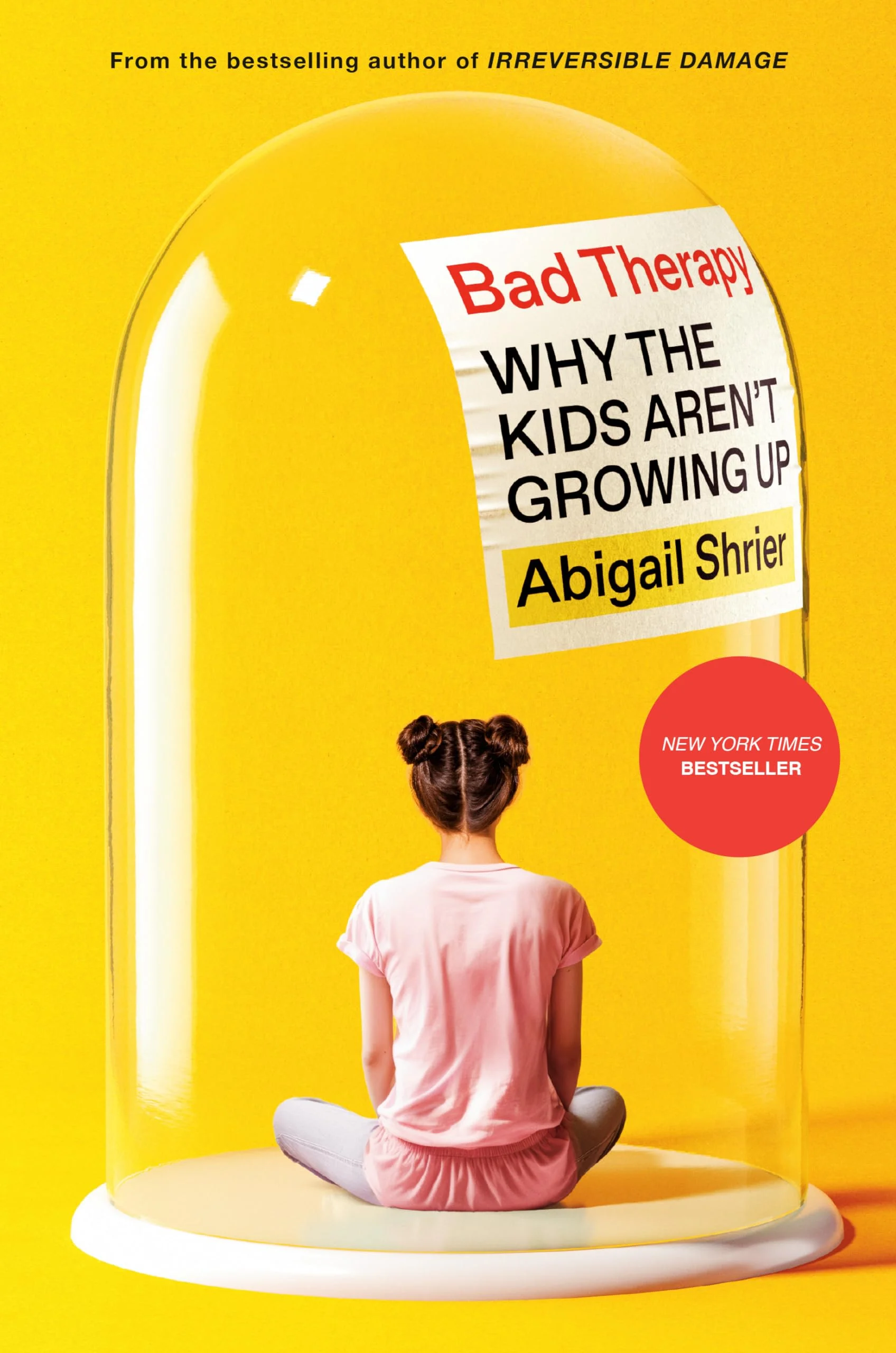
Highlights from this book
-
I’m not the only one to have found something fishy in the fact that more treatment has not resulted in less depression. A group of academic researchers recently noticed the same. They published a peer-reviewed paper titled “More Treatment but No Less Depression: The Treatment-Prevalence Paradox.” The authors note that treatment for major depression has become much more widely available (and, in their view, improved) since the 1980s worldwide. And yet in not a single Western country has this treatment made a dent in the incidence of major depressive disorder. Many countries saw an increase.
-
If you want to improve a kid’s mental health, locking up her smartphone might be a start. At a minimum, smartphones take a teen further from the world of in-person friends and activity likely to bolster her sense of well-being. They are undoubtedly responsible for exacerbating a variety of social contagions, from tic disorders to gender dysphoria. But banish the smartphone and fix a generation? I’m not so sure. Youth mental health has been in decline, after all, for the last five or six decades.
-
For most problems, Ortiz says, individual therapy has almost no proven benefit for kids. “The evidence is pretty clear that parent-based approaches are more effective.” Meaning, a therapist should treat a kid’s anxiety by treating the kid’s parents.
-
“Trying to get the patient to consider their past and how it went wrong, and what could have gone better and how should it be different, what can happen, what’s the most likely outcome and so on—a lot of these different interventions are actually worry- and rumination-increasing interventions,”
-
I asked Kennair how we could be sure that young people weren’t simply more “open” about their poor mental health? Kennair’s response was elegant and astonishing: being overly prone to talking about your emotional pain is itself a symptom of depression. “If you do this”—habitually give voice to your negative thoughts or personal problems—“you’re co-ruminating at least. But I believe they are ruminating more. And rumination is the major predictor for depression.”
-
Hang around families with young children for an afternoon, and you’ll hear parents check that their kids are enjoying their ice cream, excited about school the next day, that they had fun at the park. In so many ways, we signal to kids: your happiness is the ultimate goal; it’s what we’re all livin’ for. According to the best research, we have it all backward. If we wanted our kids to be happy, the last thing we would do is to communicate that happiness is the goal. The more vigorously you hunt happiness, the more likely you are to be disappointed.
-
A generation ago, kids might have identified with what Cody calls their “strengths”: the jock, the popular kid, the math team member, the beauty queen. But today, that’s verboten. “Identifying with your strengths now isn’t seen as too cool because some people may manipulate you into thinking that you’re privileged because of it.” What’s wrong with identifying with your struggles? “Well, I see that they don’t try to solve it.” Cody took pains to explain that he wasn’t talking about the severely depressed—just the average kid. Once they get the validation from other students for their mental health crises, “they don’t break out of that rut,” he said.
-
“Kids today are always under the situation of an observer,” said Peter Gray, a professor of psychology at Boston College and author of the classic introductory textbook on psychology. “At home, the parents are watching them. At school, they’re being observed by teachers. Out of school, they’re in adult-directed activities. They have almost no privacy.”
-
“When psychologists do research where they want to add an element of stress, and they want to compare people doing something under stress versus no stress, how do they add stress? They simply add an observer,” Gray said. “If you’re watched by somebody who seems to be assessing your performance, that’s a stress condition.”
-
Most American generations endured national hardships. But there was no rash of suicides among young southerners during the Civil War nor during Reconstruction. None among teens during the Great Depression, though they did see suicide among the adults of the time. Nor was there a rash of suicide among young adults following Pearl Harbor, when so many of them were sent off to war. Not during the Cuban Missile Crisis, when the world might actually have blinked out like a Zenith TV on the fritz, nor during the endless waves of disillusionment that accompanied the Vietnam War. The Boomers who fancy themselves having confronted some of the ugliest chapters in American history—segregation, Vietnam, Watergate—are usually the first to acknowledge that they could, and did, initiate a positive change.
-
The great Israeli sociologist Eva Illouz notes that the trauma narrative is plotted backward—from present adult dissatisfaction to the epiphany of a childhood spent in a dysfunctional family. “What is a dysfunctional family? A family where one’s needs are not met. And how does one know that one’s needs were not met in childhood? Simply by looking at one’s present situation,” Illouz writes. “The nature of the tautology is obvious: any present predicament points to a past injury.”
-
“Self-consciousness,” or what Peterson calls “self-reflection on the feeling state,” and neurotic suffering are virtually indistinguishable, clinically and psychometrically. “Insofar as you’re thinking about yourself, you’re depressed and anxious,” Peterson said. “There’s no difference between thinking about yourself and being depressed and anxious. They are the same thing.”
-
The “authoritative parent,” however, is loving and rule based. She attempts to direct the child’s activities in a rational manner, encourages a give-and-take with her child, but “exerts firm control at points of parent-child divergence.” Where her point of view on a household rule ultimately conflicts with that of her child, she wins. She maintains high standards for her child’s behavior “and does not base her decisions on group consensus or the individual child’s desires.” In studies that still manage to chagrin therapists, Baumrind found that authoritative parenting styles produced the most successful, independent, self-reliant, and best emotionally regulated kids; it also produced the happiest kids—those less likely to report suffering from anxiety and depression. This is a remarkably sturdy research finding: kids are happiest when raised in a loving environment that holds their behavior to high standards, expects them to contribute meaningfully to the household, and is willing to punish when behavior falls short. And it flies in the face of virtually everything therapists and parenting books now exhort.
-
Mayan parents on the Yucatan Peninsula; Inuit in northern Canada; and hunter gatherers in Tanzania. These parents invite their toddlers to help them with the housework; do not overly praise their kids; exert a calm, steady authority; and let their kids take risks and fail, so that they become strong. Doucleff even reluctantly admits that in nearly every culture around the world—including those she admires—parents give the errant child a brisk spanking. Doucleff envies these cultures—their confident closeness with their children; the happy, competent, generous, chore-doing kids they are raising.
-
In so many liberal American families today, she said, parents disavow their authority, give children endless choices, and constantly solicit kids’ opinions on major life decisions. But the hunger for authority and boundaries is profoundly connected to a child’s sense of self and well-being. It does not dissipate simply because parents fail to supply it.
-
Ortiz believes acts of independence can help alleviate even unrelated fears. Of his method with kids, he has joked, “So you’re scared of the dark? Go to the deli and buy me a half a pound of salami.” The child’s feeling of efficacy that results from completion of this sort of task, he says, makes kids stronger in every sense: braver, less anxious, more willing to try things that are hard, and, remarkably, less of a constant burden to their stricken parents. So far, he says, the results are promising.
-
As far as I can tell, the purpose of childhood is to allow kids to take risks—things that involve getting all kinds of hurt—and to practice the skills they will need as adults while they are still safely under their parents’ roofs. Childhood exists to allow kids to hazard an unpredictable friend, lose a ball game, stand up to a bully, pick themselves up, offer another kid a hand.